
Fall Back, Spring Forward, Is It Worth It Changing Our Clocks For Daylight Savings?
It’s that time of year again as we approach the dreaded start of daylight savings and having to “spring forward” and lose an hour of sleep. Noooooooooooooooo!

People whine, gripe and complain about how it’s so much harder to wake up on Sunday and Monday morning following the annual switch from standard to daylight time, and coping with that sudden loss of an hour. It can be somewhat of a big deal when you’ve got a standard routine and consistent times for falling asleep as well as waking up in the morning.
On the other hand, people generally love it in the fall when we go from daylight time back to standard time, and we “fall back” and gain an extra hour of sleep. Generally speaking, it’s easier on the body when you’re got that extra hour of rest. It’s not so difficult waking up for school and work on the following Monday.
In both cases, it only takes a couple of days for your body to adjust to the time change and get settled into its slightly adjusted routine.
When you consider the fact that as of 2007, standard time only lasts for four months, and that our society has greatly changed since the late 1910s when the shift to daylight time was first used in the U.S., is it still worth it changing our clocks twice a year?
What’s the point with dealing with this twice-yearly switching if it only lasts for four months? Read more…
Categories: Uncategorized, weather Tags: society, weather
Illinois Tornadoes (and videos) – February 28, 2017
On the afternoon and evening of February 28, 2017, northern and southern Illinois saw numerous tornadoes touch down in the state.

storm reports – February 28, 2017
As a comparison, here’s the severe weather outlook that was issued by the Storm Prediction Center earlier that day.

severe weather outlook – February 28, 2017
Although western and southern Missouri didn’t see any tornadoes in this batch of severe weather, that region had plenty of wind and hail damage from those severe thunderstorms. The brunt of the tornado reports occurred in streaks across northern and southern Illinois.
TORNADO VIDEOS
Washburn, Illinois:
Atlanta’s 2014 Winter Weather Crisis — Part II
Less than two weeks ago the Atlanta, Georgia metro area was hit by a relatively minor winter storm.
Two inches of snowfall shouldn’t have been a big deal.
However, that snowfall quickly melted on the roads and then changed into ice as the temperatures stayed below freezing. As the traffic came to a halt, the ice further developed and made sure that NOBODY was going to drive anywhere. The traffic jammed into one of the worst gridlocks in the past thirty years. ALL of the interstates and major roads were at a standstill as thousands of people were left stranded.
Naturally, the rest of the nation made Atlanta into a laughing stock, thinking that we couldn’t handle two inches of snow. What the ignorant people didn’t understand was that it was the ICE, and NOT the snow that was the problem. The traffic problems were further complicated with an entire city basically emptying at once along with all of the school systems in the surrounding counties.
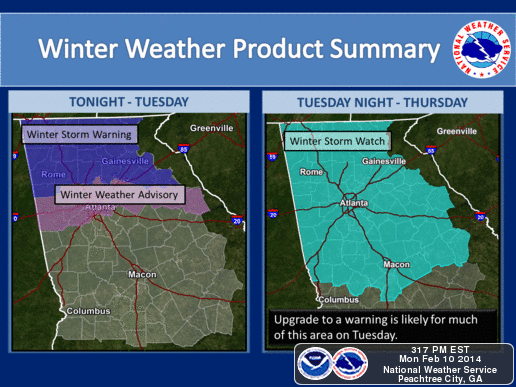
Right now northern Georgia and the Atlanta metro area is forecast for another winter storm. Actually, this time we’re forecast to be hit by two winter storms about a day apart from each other. The first winter storm is supposed to hit tonight while the second storm will be hitting the Atlanta area on Tuesday night and during the day on Wednesday.
Thanks to the madness from the last storm, right now the city and its residents are in full panic mode. Schools throughout the metro area have already announced being closed for Tuesday and Wednesday, people are flocking to the grocery stores and gas stations, and a lot of people are planning on calling out or trying to work from home for the next couple of days.
Nobody is going to be taking any chances.
And once again it’s making the city look bad. Read more…
Atlanta, Georgia Ice Storm – January 28, 2014
Some people call it Snowmageddon.
Others are calling it an ice storm.
Other people simply refer to the recent weather as “winter.”
On January 28, 2014, a snow storm swept through the Atlanta, Georgia metro area. While most areas received between two to three inches of snow, that wasn’t what made this weather event so infamous. It was the ice that froze on the road, and the driving NIGHTMARE that followed.
It’s a nightmare that, 24 hours later, is just now starting to recover.
As we know, Atlanta drivers are a rather special breed of people. Our drivers are a mix of speeders, slow drivers, those who commonly run red lights, those who merge without looking, people who drive slowly in the fast lanes of traffic, and of course, people who will pull out into traffic right in front of you. Seriously, a large percentage of the idiot drivers here should NOT have a license to drive. They’re that bad!
Naturally, these drivers are even worse when it rains. Snowfall further complicates these losers, and all hell breaks loose when there’s ice.
A lot of people are making fun of Atlanta’s drivers because of the traffic nightmare that was created. People think that the mess was because we only received a couple of inches of snow. But that’s not what happened this time. Read more…
Tornado Outbreak – Illinois & Indiana – November 17, 2013
On Sunday, November 17, 2013, the upper midwest part of the country experienced a tornado outbreak.
While tornadoes were reported in parts of Michigan, Ohio, Kentucky and Tennessee, the hardest hit states were Illinois and Indiana. Yesterday’s outbreak had a total of ninety-one tornado reports throughout the day. As of right now, the death toll stands at six.
 Tornado Outbreak Storm Reports – November 17, 2013
In this country tornadoes are rare in November and even more so in the northern states. One of the contributing factors to this severe weather was unseasonably warm weather over that part of the country.
On November 17, the town of Washington, Illinois (one of the hardest hit towns by the tornadoes) experienced a high temperature of seventy degrees. Ordinarily this town has a high temperature in the mid to upper 40s in the middle of November. In a few days this town might experience some snow fall. When you have unseasonably high temperatures and a powerful cold front advancing into the region, you know that you’ll most likely be in store for some wild weather.


The National Weather Service knew that Illinois and Indiana were going to be some of the most likely areas to be hit by tornadoes in the upcoming outbreak. The organization issued two Particularly Dangerous Situation (PDS) tornado watches that covered those states. Tornado Watch #561 was from 8:40 AM CST and lasted until 4:00 PM CST, covering almost all of Illinois and parts of Wisconsin, Iowa and Missouri. Tornado Watch #562 was from 11:20 AM until 8:00 PM EST, covering most of Indiana, the southern part of Michigan’s lower peninsula, and parts of western Ohio.
Let’s take a look at some of the tornado videos along with shots of the destruction. Read more…
November 2013 Super Typhoon Haiyan Strikes The Philippines
For those of us in the southern and eastern part of the United States, we had an easy 2013 Atlantic Ocean hurricane season.
Tropical Storm Andrea quickly developed early in the hurricane season and it struck the Florida panhandle, killing three people. After that we had two hurricanes, but neither of them struck the continental U.S. Otherwise, that’s about it as far as named tropical cyclones affecting the United States.
Over in the western part of the Pacific Ocean it’s a different story. So far the 2013 Pacific typhoon season has experienced thirty named storms with thirteen of them developing into typhoons. Ordinarily this type of news doesn’t concern us. It’s only when a super storm, such as that of Super Typhoon Haiyan, strikes a populated area that it makes the news all around the world.
Super Typhoon Haiyan was a tropical cyclone of incredible power. This is also a storm that developed quickly, going from a disorganized area of low pressure on November 2nd to a tropical storm on the 4th to a super typhoon on November 6th. Super Typhoon Haiyan reached its maximum strength right before making its first landfall in the Philippines on November 7, 2013. At that point in time the super typhoon had 10-minute sustained winds of 145 mph, 1-minute sustained winds of 195 mph, and wind gusts reaching a whopping 235 mph. If the measurements are accurate, then Super Typhoon Haiyan will hold the record of being the world’s strongest tropical cyclone to make landfall, a record that has been previously held by 1969’s Hurricane Camille.
At this point in time, the official death toll from Super Typhoon Haiyan stands at 2,275 from the Philippines alone. Of course, the areas hit hardest by the storm are still being searched and this number is expected to rise. Some parts of the Philippines estimate that the final death toll may reach 10,000 victims. Read more…
Tropical Storm Karen – final update
Throughout the day on Saturday, October 5, Tropical Storm Karen continued to weaken as it approached the northern Gulf of Mexico.
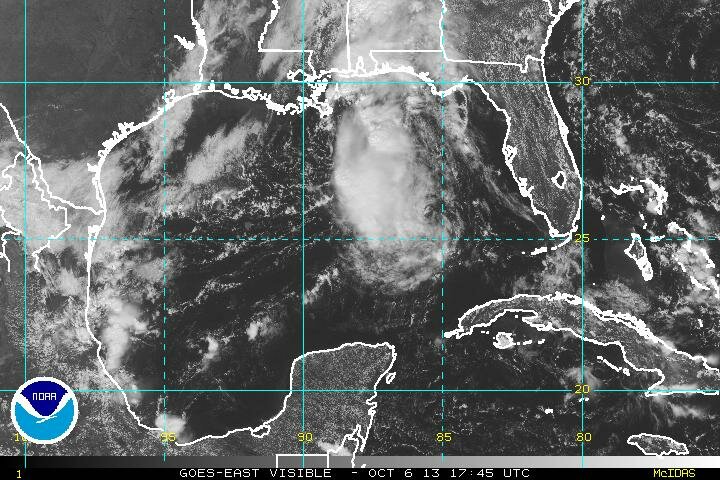
The maximum sustained winds decreased to a point where Tropical Storm Karen was downgraded to a tropical depression. As of 11 am EDT this morning, Tropical Depression Karen dissipated. The storm system is now just an unorganized mass of wind and rain as it tracks due east at 13 mph.
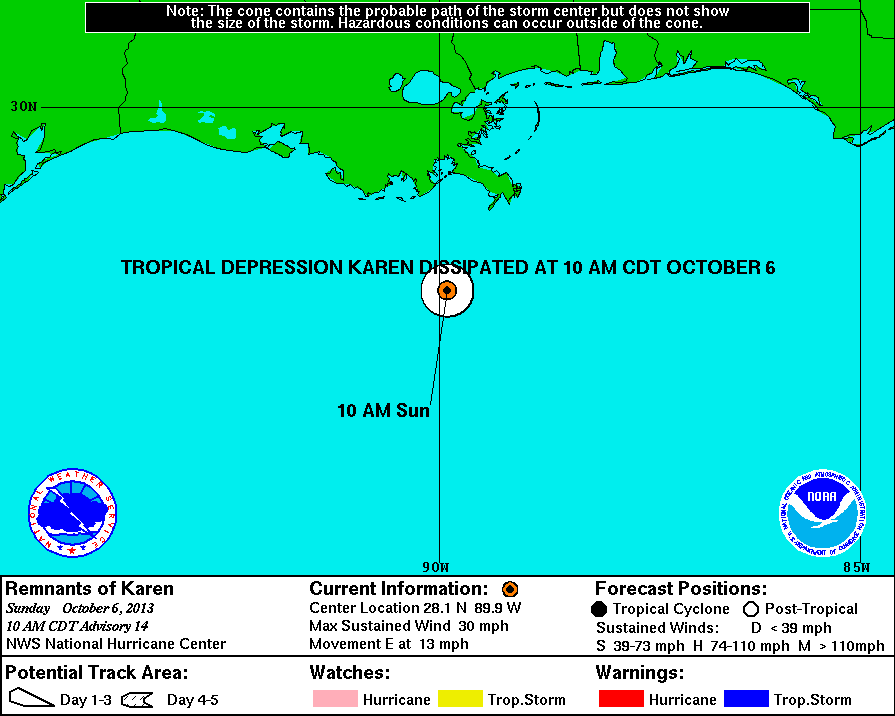
According to the last public advisory, the remains of Tropical Storm Karen were located about 85 miles southwest from the mouth of the Mississippi River. The storm’s maximum sustained winds were measured at 30 mph, and the system is tracking to the east at 13 mph. A cold front moving across the southern states is assisting with the storm’s movement to the east.
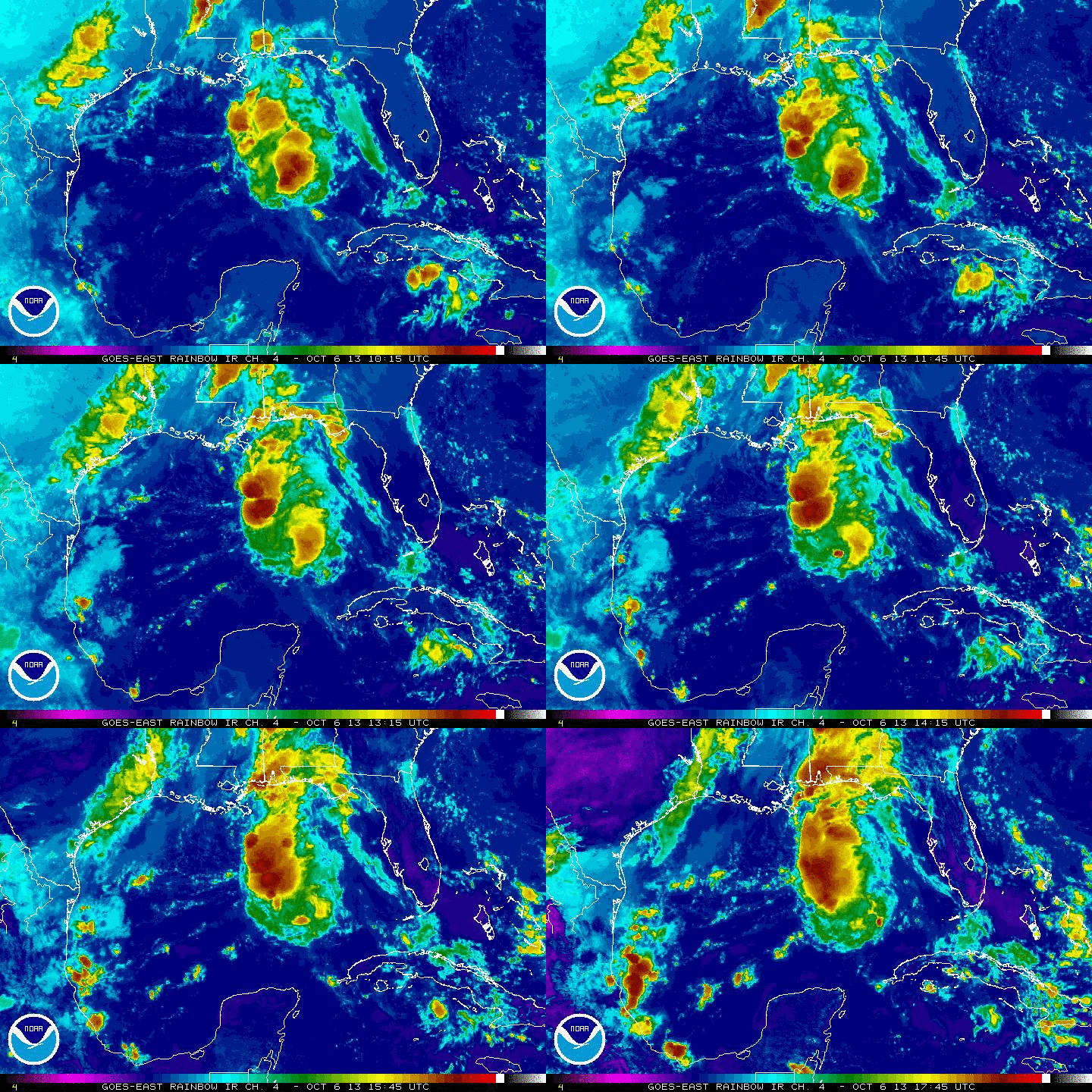
Northern Florida and parts of southern Georgia and the coastal area of South Carolina can expect extended periods of rainfall and the possibility of localized flooding. In addition to the rain, those areas can also expect strong and steady wind with gusts reaching thirty to forty miles per hour.
That concludes our coverage of Tropical Storm Karen.
Tropical Storm Karen – Update #1
It’s been 36 hours since our initial look at Tropical Storm Karen in the Gulf of Mexico.
As of the original posting, the tropical storm has moderately weakened.
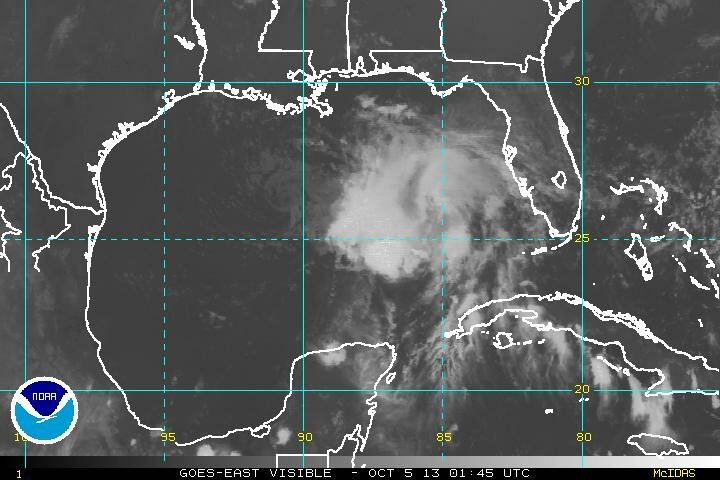
The latest public advisory states that Tropical Storm Karen has maximum sustained winds of only 45 mph. Remember that for a tropical cyclone to be classified as a tropical storm, it must have 1-minute maximum sustained winds between 39-72 mph. So with the storm’s maximum sustained winds of only 45 mph, that means that the storm is barely strong enough to still be classified as a tropical storm. If the winds sink below the 39 mph mark then it will be downgraded into a tropical depression.
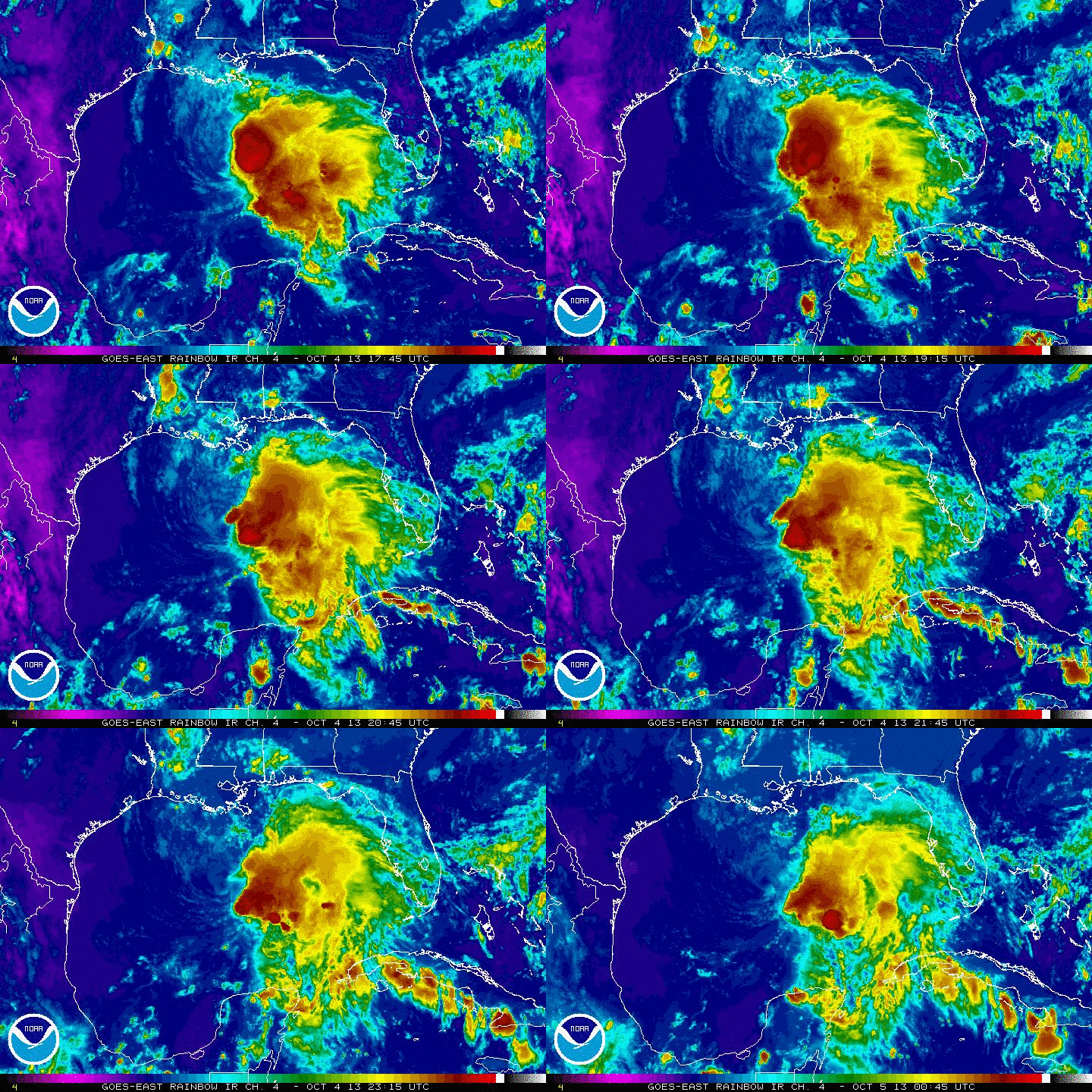
Tropical Storm Karen is currently located about 205 miles to the south-southwest of the mouth of the Mississippi River, and about 230 miles south of Morgan City, Louisiana. The storm is still moving to the north-northwest at about 7 mph, though it’s forecast to make a sharp turn to the east within the next 24-36 hours. Read more…
Tropical Storm Karen – A First Look
After what has been an eerily quiet 2013 Atlantic hurricane season, we finally have our first major storm taking direct aim at the United States.

TROPICAL STORM KAREN developed into an organized storm some time late last night or early this morning after passing over Mexico’s Yucatan Peninsula.
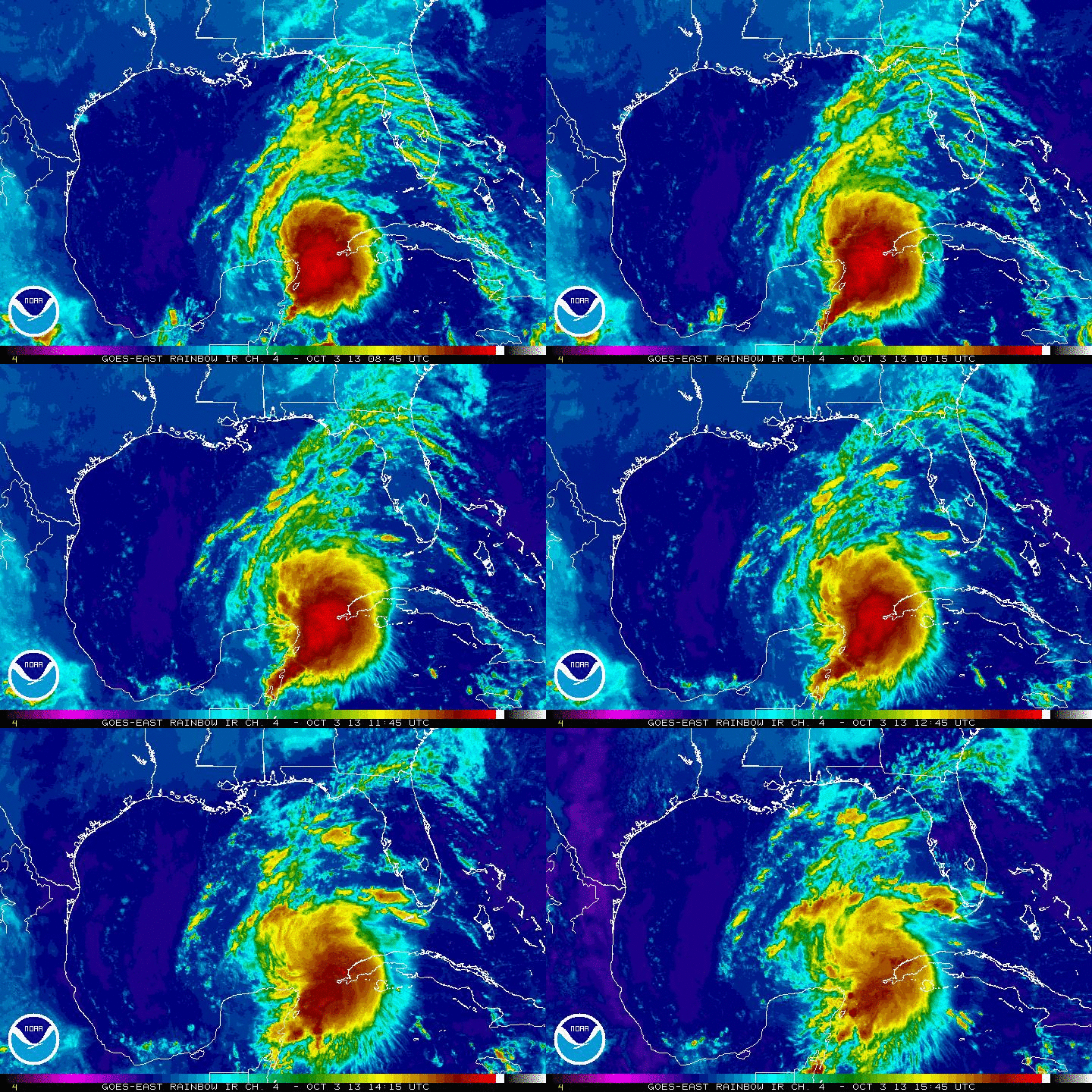
As of the latest public advisory, Tropical Storm Karen is located in the Gulf of Mexico about 45 miles north of Mexico and 485 miles south of the mouth of the Mississippi River. The storm has maximum sustained winds of 65 mph, and the tropical system is tracking to the north-northwest at around 12 mph.
Right now the satellite views don’t look too impressive. We can see the beginning stages of the storm rotating around a central point, but there is no “eye” or distinct point of central rotation.
The forecast by the National Hurricane Center is calling for gradual strengthening of the storm for the next 24-48 hours, probably reaching hurricane strength. After that point the wind shear is expected to intensify and weaken the storm before it makes landfall between Grand Isle, Louisiana and Indian Pass, Florida. Read more…
Moore, Oklahoma EF-4 / EF-5 Tornado Videos (May 20, 2013)
There’s no doubt that yesterday’s tornado that struck the town of Moore, Oklahoma was a devastating event.
The tornado’s damage path is around seventeen miles long and about a mile wide. Entire neighborhoods have been erased from the map. Two schools were heavily damaged from the storm. Hundreds of cars were tossed aside like toys. Around 20,000 families have been displaced because of the tornado’s incredible path of destruction.
Sadly, 237 people were injured from the storm, and as of the last official statement, 24 people were killed. Last night the death toll was 51 people, but that number was lowered this morning by the office of the medical examiner. The excuse for having an incorrect death count was that apparently many of the victims were counted twice.
The National Weather Service is still examining the wreckage and making a decision about the true power of the storm. We know that the tornado was at least a strong EF-4 tornado, but latest reports claim that destruction has been found that equals the incredible power of an EF-5, the strongest class of tornadoes. Word has it the tornado had a peak wind speed of a whopping 210 mph.
In reality, the ultimate strength of the May 20, 2013 tornado that struck Moore, OK is meaningless. It’s just a statistic for the record books. The reality is that this was a monster storm that nearly wiped out an entire town. The incredible amount of damage stretches for miles and miles in that section of the greater Oklahoma City metro area.
For the residents of Moore, OK, tornadoes are just a part of life. The town is located in the heart of Tornado Alley, and it’s been struck by deadly tornadoes at least five times since 1998. Until yesterday, the most destructive tornado to hit the city was an F5 tornado on May 3, 1999. That storm had the strongest tornado winds ever recorded and was responsible for the deaths of thirty-six people.
VIDEOS OF THE MAY 20, 2013 MOORE, OKLAHOMA TORNADO:
time-lapse video of the tornado recorded from a news helicopter
————————————————
tornado footage recorded from outside of town
Read more…
North Georgia Tornadoes and Repeated Weather Patterns
Earlier today on January 30, 2013, northern Georgia experienced an intense squall line associated with a strong cold front sweeping through the Great Plains, upper midwest and southern part of the country.
The region had been experiencing unseasonably warm weather for the past couple of days, and the Atlanta area flirted near 70 degrees Fahrenheit before today’s storms arrived. Considering that it’s the end of January, that kind of a high temperature is quite impressive. It also tells you that something big with the weather is about to occur. You don’t reach high temperatures like that in the winter without “paying” for it. As of right now the storms have passed and we’re dropped twenty degrees in temperature with our low tonight expected to be around freezing. In other words, we went from an early spring back to winter in the course of a few hours.
WSB-TV news footage of the Adairsville, Georgia, tornado
The deadliest part of today’s weather occurred when an estimated EF-2 or possibly EF-3 tornado ripped through the Adairsville, Georgia, area, destroying parts of the town and shutting down interstate 75 for a brief period of time. One person was killed and fourteen others were injured. About 100 cars have been reported to have been tossed around and flipped over by the tornado.
Just north of Adairsville, the outskirts of Calhoun, Georgia, was also hit by a tornado. Eight people were reported to have been injured and local damage includes homes and poultry farm buildings.
As an avid storm watcher, it’s interesting watching the formation and progress of these supercell thunderstorms and how many of the thunderstorm cells tend to hit the same areas of town. Keep in mind what I’m about to discuss is just a theory based on general observations made over the past few years. I don’t have solid facts in front of me right now. Read more…
Movie Review – Twister (1996)
When it comes to Hollywood making movies about meteorological events, whether it’s large or small scale, it’s often hard to find that right blend of real science and movie magic.
Sometimes you just need to shut off your brain, sit back, and enjoy a Hollywood blockbuster movie.
This is the case with 1996′s hit movie thrill ride, Twister.

Directed by Jan de Bont, Twister stars Bill Paxton and Helen Hunt as Bill Harding and Dr. Jo Harding, two storm chasers in the process of getting a divorce while trying to implement their new data-gathering weather instruments in the path of a tornado. The technology will allow them to accurately record the wind speeds and other aspects of the tornadoes, giving scientists better data to study and make more accurate warning systems. The problem, however, is that the data-gathering instrument, nicknamed Dorothy, has to be placed directly in the path of an oncoming tornado.
Cary Elwes plays the role of Dr. Jonas Miller, a rival storm chaser out to make money instead of pursuing the storms for the science. Jami Gerz has the role of Dr. Melissa Reeves, Bill’s new fiancée who happens to work as a reproductive therapist. Some of the fellow storm chasers are played by Philip Seymour Hoffman, Alan Ruck and Jeremy Davies.

Twister (1996) – (c) Warner Bros.
Twister begins in June of 1969 out in the Great Plains. An ordinary night at Jo’s parent’s farmhouse turns into a disaster as an F5 tornado (the strongest class of tornado on the Fujita scale) bears down on their home. Young Jo and her parents rush outside to the underground storm shelter. The powerful tornado arrives and Jo’s father tries to hold the door closed to protect the family. The tornado’s winds rip off the door and carry away Jo’s father, killing him. Read more…
Categories: movie reviews Tags: disaster film, movie review, tornado, weather
The Aftermath and Politics of Hurricane / “Super Storm” Sandy
On October 29, 2012, Hurricane Sandy came ashore near Atlantic City, New Jersey as a Category 1 hurricane.
Although the hurricane wasn’t packing very strong winds (at least, compared to what hurricanes could really do), the primary destruction from the cyclone was from the incredible storm surge. Unfortunately for the coastal residents and businesses stretching from Delaware to Connecticut, Hurricane Sandy came ashore at night during high tide, adding that much more water flooding the region.
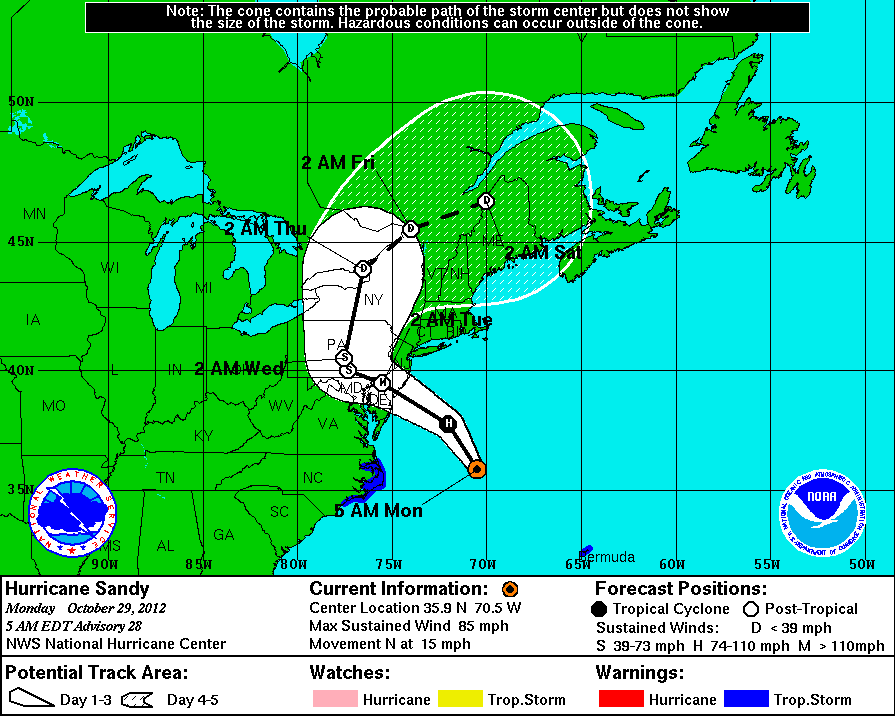
Hurricane Sandy approaching New Jersey.
Another factor with Hurricane Sandy and its total area of destruction was a result of the storm’s massive size. As the storm closed in on the northeast coast, Hurricane Sandy had a diameter of about a thousand nautical miles. It wasn’t just a small area that felt the effects of the storm — it was the entire region of the northeast.
Hurricane Sandy making landfall in New Jersey.
Fortunately, residents had plenty of warning about the approaching storm. The computer models were fairly accurate several days in advance of the storm making landfall in New Jersey, giving people plenty of time to leave the area. Many of those who left the area would be completely shocked at the amount of destruction when they return home. Read more…
Categories: weather Tags: government, hurricane, weather
Hurricane Isaac – The Flooding of Mississippi and Louisiana
Hurricane Isaac made landfall last night on southeastern Louisiana as a Category 1 hurricane with winds gusting to 85 mph.

Ordinarily, a hurricane this weak wouldn’t draw the attention that this current storm is receiving. The problem with Hurricane Isaac is where it made landfall and where the brunt of the wind, rain and storm surge is going. And that direction is the Mississippi Gulf Coast along with New Orleans, Louisiana.

As we learned in school, hurricanes rotate counter-clockwise around the center of the storm, also known as its “eye.” When you factor in the cyclone’s forward motion, the most intense part of the storm is the upper-right quadrant. The winds are often slightly higher in this quadrant, and they increase in speed the closer you are to the eye of the storm. Read more…
Tropical Storm / Hurricane Isaac – Update #4
It’s been almost 48 hours since our last update, and Tropical Storm Isaac has finally strengthened enough to reach hurricane status.
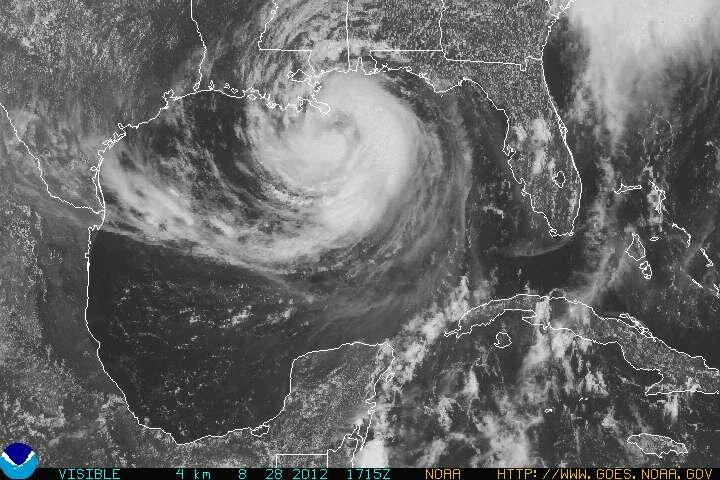
Hurricane Isaac’s projected path has finally narrowed and there’s little discrepancy amongst the computer models. Yes, folks, Hurricane Isaac is taking aim at New Orleans, Louisiana. The city is once again being targeted by a tropical cyclone. At least this time the damage should be significantly smaller than when Hurricane Katrina struck the city back in 2005.
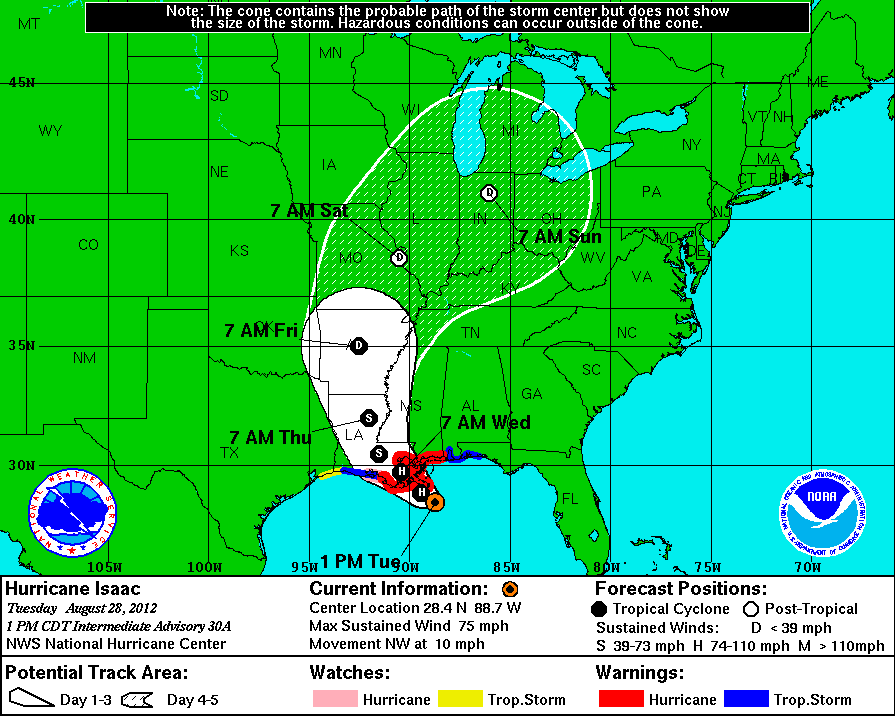
The latest advisory by the National Hurricane Center in Miami, Florida, places Hurricane Isaac about 55 miles south-southeast of the mouth of the Mississippi River, and roughly 135 miles southeast of New Orleans, Louisiana. Hurricane Isaac has winds measured at 75 mph, just strong enough to classify the tropical cyclone as a hurricane. Hurricane Isaac is currently tracking to the northwest at around 10 mph, though there was some reported wobble to the hurricane’s path. Read more…
Tropical Storm / Hurricane Isaac – Update #3
We’re now a couple of days later, and Tropical Storm Isaac is bearing down on the Florida Keys.
Over the past 48 hours, Tropical Storm Isaac has drenched Haiti along with parts of the Dominican Republic and the southern Bahamas, causing some damage along with mudslides from the torrential rains. The tropical cyclone then passed close to Cuba and moved along the northern coast of the island nation, staying over the water most of the time.

Despite all of its time over warm water, Tropical Storm Isaac has only strengthened a little since we last examined the storm two days ago. The latest advisory by the National Hurricane Center of Miami, Florida, lists the storm’s maximum sustained winds to be only around 60 mph. Remember that a tropical cyclone needs to have winds of at least 74 mph to reach the strength of a hurricane.
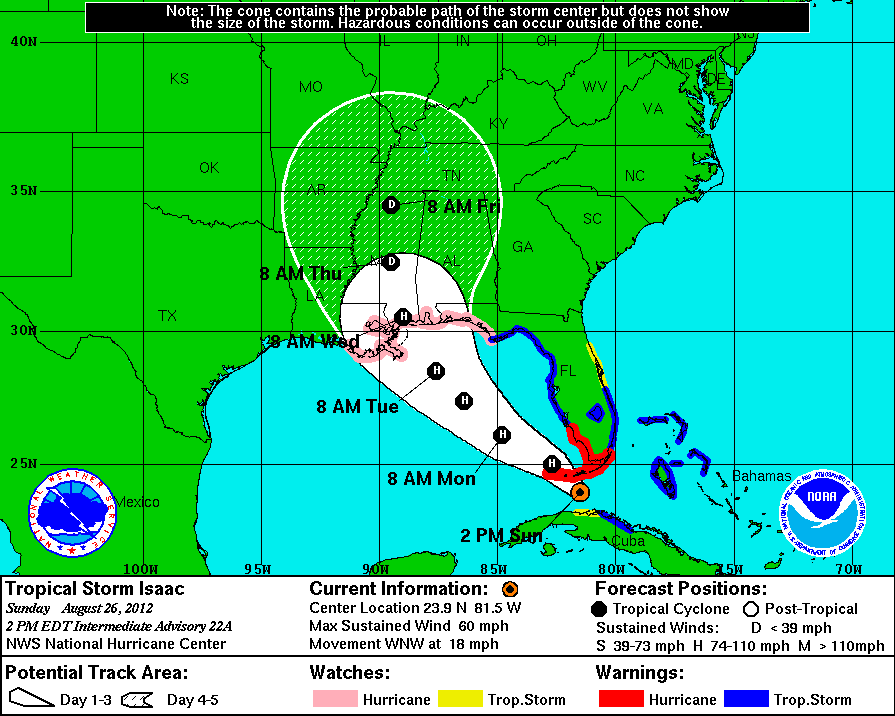
As of an hour ago, Tropical Storm Isaac was about 50 miles to the south-southeast of Key West, Florida. The storm’s maximum sustained winds were still only about 60 mph. Right now Tropical Storm Isaac is tracking to the north-northwest at 18 mph. Read more…
Tropical Storm / Hurricane Isaac – Update #2
Tropical Storm Isaac has continued with its westward movement through the northern Caribbean Sea. Impact on the western part of Hispaniola seems imminent.
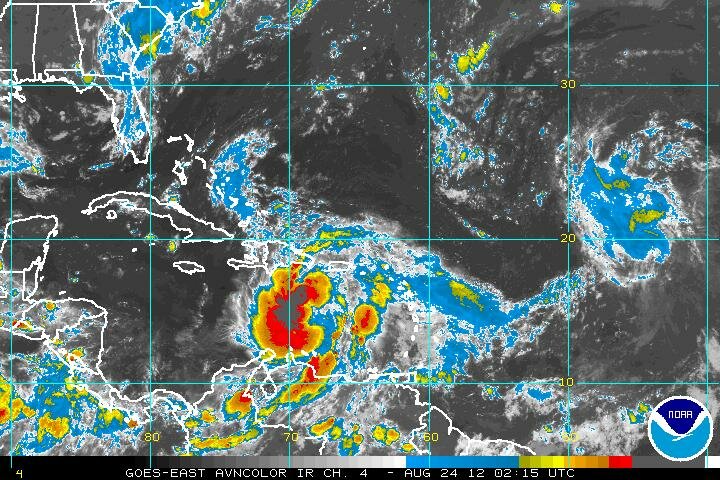
The latest advisory by the National Hurricane Center in Miami, Florida, places Tropical Storm Isaac about 145 miles to the south-southeast of Santo Domingo, Dominican Republic. The storm has shifted slightly to the north and is tracking now to the west-northwest at 18 mph. The storm’s maximum sustained winds are still only around 45 mph, keeping Isaac a relatively weak tropical storm.

The official forecast by the NHC has shifted Tropical Storm Isaac’s official path more to the west, putting it possibly in line with Mobile, Alabama and Biloxi, Mississippi. The storm may pass over the Florida Keys, but right now it looks like the Florida peninsula may not be affected by the storm. The Florida panhandle, on the other hand, is a different story. Read more…
Tropical Storm / Hurricane Isaac – Update #1
It’s been twenty-four hours since the last update, and Tropical Storm Isaac has now crossed the northern Lesser Antilles and entered the warm waters of the Caribbean Sea.

According to the latest advisory by the National Hurricane Center in Miami, Florida, Tropical Storm Isaac is about 270 miles southeast of San Juan, Puerto Rico. The tropical cyclone is currently tracking to the west at 20 mph. Right now Tropical Storm Isaac still has maximum sustained winds of 45 mph, keeping it at the lower end of the 39-73 mph wind speed requirement for classification as a tropical storm.

The official forecast is still keeping Florida in the sights of Tropical Storm Isaac. The forecast has shifted slightly to the west and now places the tropical cyclone possibly striking the Gulf Coast of Florida. The timing with this storm is rather interesting as this Monday starts the Republican National Convention in Tampa, Florida. Read more…
Tropical Storm / Hurricane Isaac – A First Look
It’s been about two weeks since we were last discussing tropical storms and the potential for another hurricane in the 2012 Atlantic Ocean hurricane season.
The last couple of storms sort of fizzled out and posed no threat whatsoever to the continental U.S. This latest storm, Tropical Storm Isaac, looks like it could be rather interesting for residents in Florida and the southeastern United States.
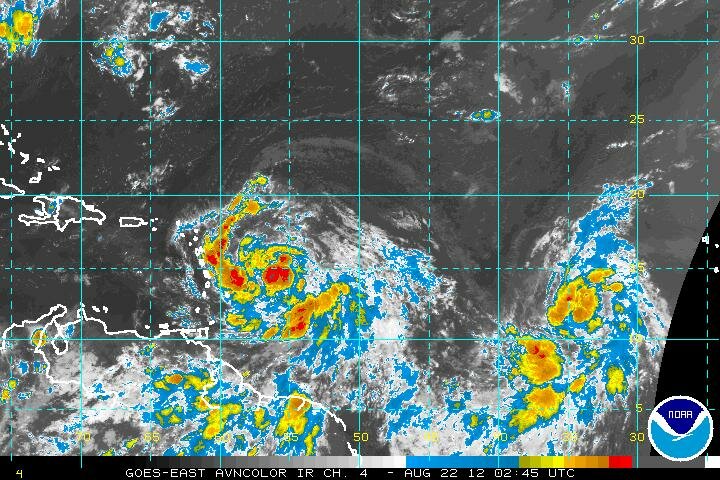
Tropical Storm Isaac recently strengthened from a tropical depression into a tropical storm.
The latest public advisory from the National Hurricane Center in Miami, Florida, places Tropical Storm Isaac in the Atlantic Ocean about 390 miles east of the island of Guadeloupe. The tropical storm currently has maximum sustained winds of 40 mph, and it’s currently tracking to the west at 18 mph.

Computer models are predicting a decrease in the wind shear currently affecting the tropical storm, thus allowing the storm to increase to a hurricane within the next couple of days. With this forecast in mind, hurricane watches are already in effect for Puerto Rico and the U.S. Virgin Islands. Read more…
Tropical Storm Ernesto – Update #2
Twenty-four hours later and it appears more and more likely that Tropical Storm Ernesto is taking the southern route through the western half of the Caribbean Sea. Right now the computer models are placing the tropical storm’s path on a direct path towards Belize and southern Mexico.

One of the interesting things about Tropical Storm Ernesto is that the storm has not really strengthened since it officially became a tropical storm a few days ago. In fact, despite being in warm and calm waters, the storm is actually less organized now than it was the other day.

Right now Tropical Storm Ernesto is about 205 miles south-southwest of Kingston, Jamaica, and about 355 miles east of the Nicaragua/Honduras border in Central America. The storm still has maximum sustained winds of 50 mph with gusts up to 65 mph, keeping it a solid tropical storm. Its movement is currently to the west at a quick pace of 23 mph. Read more…